CRM vs Spreadsheet: Best for Mobility Sales Leads?
CRM, Mobility Retail, Sales Leads
CRM vs Spreadsheet: Which Is Better for Managing Mobility Sales Leads?
Should your mobility retail business manage sales leads in a spreadsheet or a CRM? Explore the real-world pros, limitations, costs and clear signs it may be time to upgrade.
Why This Decision Matters for Mobility Retailers
For many mobility businesses, the first sales "system" is a spreadsheet. And in the early days, there is nothing wrong with that. A simple sheet can record who enquired, when you made contact, which scooter or rise-and-recline chair they were interested in, and whether someone needs to call them back. When enquiry volumes are modest, and one person handles most of the follow-up, that may be all you need.
The problem is what happens later. The business grows. Another column gets added. Then another tab. Someone creates a second version. A salesperson downloads their own copy. Follow-up dates are entered, but nobody checks them consistently. Notes start appearing in email inboxes and notebooks instead of the spreadsheet. Eventually, you technically have a lead-management system, but nobody is completely confident that it reflects what is actually happening.
That is usually when the question arises: “Do we need a CRM, or can we carry on using a spreadsheet?" The answer depends less on fashion and more on what you need the system to do. A spreadsheet and a CRM are not really the same thing. A spreadsheet is very good at storing information. A CRM is designed to help manage a relationship and the actions surrounding it. That distinction becomes increasingly important as a mobility business grows and as expectations around responsiveness and aftercare increase globally.
What Spreadsheets Still Do Well
Spreadsheets often get criticised unfairly. For a small mobility retailer with a straightforward sales process, they can be extremely useful. You can record basic customer information, enquiry dates, product interests, quotation values and sales outcomes. You can filter the information, build simple reports and share a file with other members of the team. And, importantly, the cost is usually very low or effectively free if you already use tools like Excel or Google Sheets.
If you receive a modest number of enquiries and one or two people handle most sales activity, a well-designed spreadsheet may be perfectly adequate. There is no reason to buy technology simply because other businesses use it. If the spreadsheet gives you the information you need, staff use it consistently, and genuine leads aren't being missed, it may still be doing its job. The danger is not using a spreadsheet. The danger is continuing to use one after the business has outgrown what it can comfortably manage.
Where Spreadsheets Start to Struggle in Mobility Sales
A spreadsheet usually records what has happened. A sales process also needs to manage what should happen next. That is where the gap often begins. Imagine a customer enquires about a mobility scooter and says, "Can you call me next Thursday after I've spoken to my daughter?" A salesperson types "Call Thursday" into a notes column. What now makes sure that call actually happens?
Usually, the answer is the salesperson's memory or personal system. Perhaps they put it in their diary. Maybe they remember. Perhaps they create an Outlook reminder. Or maybe Thursday becomes busy, the call slips into Friday, then Monday, and eventually the customer buys elsewhere. The spreadsheet contained the information. What it did not do particularly well was manage the action. That is one of the fundamental differences between a spreadsheet and a CRM, especially in a sector where purchases are high-consideration and customers often need several conversations before deciding.
What a Modern CRM Adds – Beyond a Better List
CRM stands for Customer Relationship Management. In practical terms, a CRM helps the business manage customers and sales opportunities from one stage to the next. A new enquiry can be assigned to a particular person. The salesperson records the conversation. A next action is scheduled. A home assessment is arranged. The opportunity moves to quotation. A follow-up task is created. The quotation is either won, lost or moved to a future date. The customer history remains visible to the whole team, not just the person who took the original call.
In 2026, leading CRMs have gone further. They are no longer just systems of record; they are becoming systems of action. Using embedded, “agentic” AI, many platforms can now automatically log emails, suggest next steps, schedule reminders and even send follow-up messages within guardrails you define (cio.com). For a mobility retailer, that could mean the CRM prompts, "Call Mrs Patel on Tuesday to confirm scooter dimensions," or automatically flags that a high-value quote has not been touched for seven days.
💡 Key idea: A spreadsheet stores data. A CRM stores data and actively helps you use it to move leads forward.
CRM vs Spreadsheet: Practical Comparison for Mobility Sales Leads
Area | Spreadsheet | CRM |
|---|---|---|
Basic customer details | Very good | Very good |
Recording enquiries | Good | Very good |
Cost | Usually low | Monthly subscription likely |
Setting up | Relatively simple | More planning required |
Assigning lead ownership | Possible manually | Usually built in |
Follow-up reminders | Manual or separate system | Usually built in |
Customer history | Can become difficult | Typically centralised |
Sales pipeline visibility | Possible, but manual | Core functionality |
Multiple users | Can become awkward | Designed for teams |
Reporting | Requires setup | Usually more accessible |
Automation | Limited | Often available (e.g. reminders, emails, AI agents) |
Tracking lost sales | Possible manually | Easier to structure and report |
Managing future opportunities | Can become cumbersome | Usually easier |
Scaling with the business | Limited | Generally stronger |
The CRM appears to win most of that comparison. But that does not automatically mean you should buy one. The key question is whether those additional capabilities solve problems you have today or expect to face as you grow.
Benefits of CRM for Mobility Sales In Plain Language
Clear lead ownership: Every enquiry belongs to someone, with visibility of who owns it, what happened last and what happens next.
Consistent follow-up: Built-in reminders, tasks and AI prompts dramatically reduce the risk of forgetting calls or quotations.
Single version of the truth: One customer record, one pipeline, accessible from anywhere – instead of multiple spreadsheets and inboxes.
Better quotation control: Quickly see which quotes are active, which are overdue for follow-up and which have been lost – without hours of manual checking.
Knowledge retention: Capture key details that currently live only in people’s heads – who prefers morning appointments, who is likely to upgrade next year, who has a relative that handles decisions.
Service and aftercare visibility: Track not just the initial sale, but servicing, repairs and repeat purchases over time, giving a fuller picture of customer value.
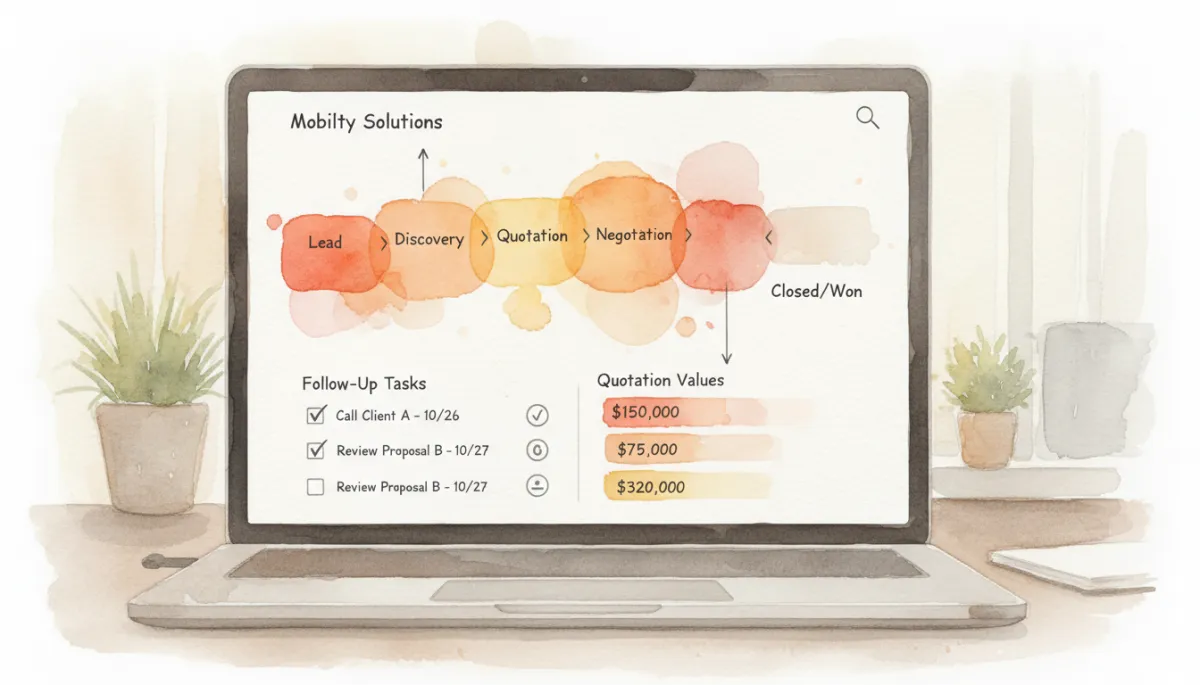
A clear CRM pipeline makes it harder for valuable mobility leads to disappear.
Costs: "Free" Spreadsheets vs Paid CRM: What's the Real Price?
On paper, spreadsheets look cheaper. Most businesses already own spreadsheet software, and cloud tools like Google Sheets have no extra licence cost. CRM, by contrast, usually means a monthly subscription. In 2026, entry-level CRM plans from mainstream providers typically start between £9 and £25 per user per month, with more capable "business-ready" tiers ranging from around £23 to £100 per user per month (CRM Newspaper).
For example, HubSpot offers a free CRM for very small teams, while paid Starter tiers can begin at roughly £7–£20 per seat per month, with more advanced Professional and Enterprise plans costing £90–£150 per seat plus onboarding fees (aimarketer.com). Salesforce’s Sales Cloud starts around £25 per user per month for its Starter Suite, rising to £100–£550 per user per month for more powerful plans with AI and advanced analytics (salesforce.com).
Those figures can sound high compared with a “free” spreadsheet. But a more accurate comparison is the cost of the CRM versus the cost of the problem it helps you solve. Imagine your current process contributes to just two opportunities being missed each month – perhaps one enquiry is forgotten, and another quotation is not followed up. If each lost sale could have generated £700 in gross profit, that represents £1,400 a month, or £16,800 over a year. In that context, a £100–£200 monthly CRM subscription can be an investment in plugging leaks rather than a pure overhead.
When a Spreadsheet May Still Be Enough
Consider a small independent mobility retailer where the owner handles most enquiries. Perhaps there are 20 or 30 genuine sales opportunities each month. The owner knows the customers personally, the quotation process is straightforward, and follow-up happens consistently. Visibility is strong, and reporting is simple. In that situation, introducing a CRM may provide very little immediate benefit and could even create unnecessary administration.
If the business already controls its opportunities effectively, it shouldn't introduce technology just to make the process look more sophisticated. Good systems should reduce friction, not create it. You may simply need a better-designed spreadsheet: clearer status fields, a proper owner for each opportunity, a next-action date and consistent lost-sale reasons. Sometimes improving those basics gives a small business everything it needs for the next stage.
Signs It May Be Time to Upgrade from Spreadsheet to CRM
Leads are being missed or forgotten. Enquiries slip through the net, or you discover customers have bought elsewhere before you responded.
Several people are involved in each customer journey. Different team members handle website leads, showroom visits, and home assessments, and coordination is becoming difficult.
Quotation follow-up is inconsistent. You cannot quickly see which quotes are active, which are overdue, and which have been lost.
Management lacks clear pipeline visibility. To answer "What are we likely to close this month?" someone has to manually combine several spreadsheets or chase salespeople individually.
Customer information is scattered. Some details live in spreadsheets, some in emails, some in notebooks and some in people's heads.
Future opportunities and service reminders are hard to manage. Customers who may buy later, or who will need servicing, are not tracked in a structured way.
Reporting takes hours. Producing basic insights – such as conversion rates or average quote value – means exporting, merging and cleaning data every time.
📌 Key takeaway: You do not need a magic number of staff or leads. You need to notice when your current system no longer protects revenue or gives you control.
Process First, Technology Second
A CRM is not automatically better customer service. You can have an expensive CRM and still provide a poor experience. A system can remind somebody to call; it cannot make the conversation helpful. It can record the customer's circumstances; it cannot make an employee genuinely listen. It can show an overdue quotation; it cannot decide how the retailer should communicate value. Technology supports behaviour; it does not replace it. That is why the most successful mobility retailers tend to follow a simple rule: process first, technology second.
Before moving from a spreadsheet to CRM, map your current customer journey. What happens when a new enquiry arrives? Who owns it? How quickly should they respond? What happens if you can't reach the customer? How is an assessment arranged? What happens after a quotation? How long should an opportunity remain active? How do you record why sales are lost? What happens to customers who may buy later? Once you answer those questions, your CRM requirements become clearer, and you are less likely to pay for features you will never use.
Thinking Beyond the Initial Sale
A conventional sales spreadsheet often stops once you win the opportunity. But in mobility retail, the relationship may continue for years. A scooter may later require servicing, batteries, tyres or repairs. The customer's circumstances may change. They may require different equipment, or they may recommend a friend or relative. The right CRM can help you see this bigger picture, how many products and services a customer uses, how often they buy, and how satisfied they are over time.
In 2026, many CRMs integrate tightly with service and marketing tools, and some even use AI to highlight when a customer might be due a check-up or when a battery replacement is likely. You may not need every advanced feature, but a single, reliable history means any member of your team can pick up the relationship without starting from scratch, whether the customer walks into your showroom in Manchester, calls from Melbourne, or emails from Madrid.
So, Which Is Better for Managing Mobility Sales Leads?
For a small mobility retailer with a manageable volume of leads and a simple, disciplined sales process, a well-managed spreadsheet can be perfectly good. For a growing business with several users, more enquiries, larger quotation volumes and a greater need for visibility and control, a modern CRM will usually provide far stronger support. In both cases, the key phrase is well managed. A poor spreadsheet will lose opportunities. A poorly implemented CRM will do exactly the same thing at a higher monthly cost.
The best system is the one your team actually uses – consistently, accurately and in line with a clear process. For some mobility businesses, that is still a spreadsheet. For others, continuing with spreadsheets has quietly become part of the problem. The key is recognising when that point has arrived, then choosing technology that genuinely helps you close more of the right opportunities, look after customers better, and protect the revenue you are already working hard to generate.
Before You Change Systems, Identify Where You're Losing Money
Do not begin with "Which CRM should we buy?" Begin with "Where are we losing control of the customer journey?" Are enquiries being missed? Is follow-up inconsistent? Are quotations disappearing? Is customer information difficult to find? Are future opportunities being forgotten? Do managers lack visibility? That diagnosis will tell you far more about what your next system needs to do than any feature checklist.
Buying CRM software is not the objective. The objective is a sales and service process that converts more opportunities, gives customers a better experience, and gives management greater control. Sometimes a spreadsheet can still do that. Sometimes it cannot. Knowing the difference and acting at the right time can save you both money and lost sales.
🔍 Next step: If you are considering moving from spreadsheets to CRM, first understand where revenue may already be leaking – whether through lead response, quotation follow-up, conversion, aftercare or customer retention. Tools like the MG Retail Consulting Revenue Leak Finder help mobility retailers pinpoint which areas deserve attention first, before you invest in new technology.
🔍 Where Is Your Business Losing Money?
If you are considering moving from spreadsheets to CRM, first understand where revenue may already be leaking from the business.
The issue may be your systems.
But it could also be lead response, quotation follow-up, conversion, aftercare or customer retention.
The MG Retail Consulting Revenue Leak Finder can help you identify which areas deserve attention first.
Take the Revenue Leak Test here: